What is Serigraph Printing?
Serigraphy—also called silk screening, screen printing, or serigraph printing—is a stencil‑based process that pushes ink through a fine screen onto paper. Early screens were made of silk, but artists now use finely woven polyester or nylon.
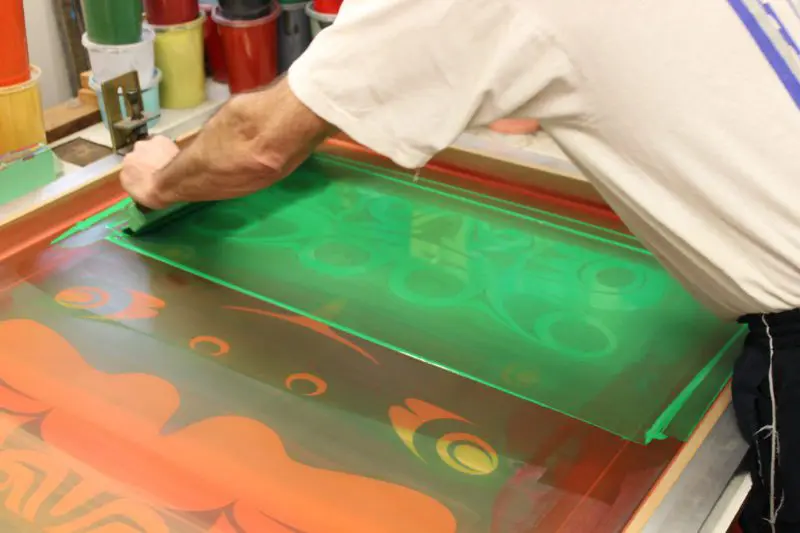
The screen stretches over a wood or aluminum frame. A stencil blocks out selected areas, creating the negative image. The artist places the screen on paper, adds ink, and pulls a rubber squeegee across the surface. Ink passes through the open areas and transfers to the paper.
Each colour requires its own screen. Layering these colours creates rich saturation, strong texture, and depth.
Why the different names?
Artists use the term serigraphy. It distinguishes fine‑art printing from industrial screen printing. The word combines the Latin seri (silk) and the Greek graphein (to write or draw).
A brief history of serigraphy
Serigraphy is the oldest printing method. Its roots trace back to the Song Dynasty (960–1279 AD) and later to 15th‑century Japan, where artists used it to transfer designs onto silk.
The technique reached the West in the late 18th century. It grew slowly until the early 20th century, when silk mesh became easier to obtain and new commercial uses emerged. Europeans first used it to print luxury wallpaper on linen, silk, and other fine fabrics. As demand grew, serigraphy became an important industrial process.
In North America, serigraphy became recognized as an art form in the 1930s. A group of artists—later the National Serigraphic Society—coined the term serigraphy to separate their work from commercial printing. Andy Warhol later helped popularize the technique in the art world.
Are serigraphs reproductions?
No. Serigraphs are original artworks. Unlike reproduction prints, which simply copy an existing image, serigraphy requires two artists: the original creator and the printer.
Although automated machines exist, the printer we work with creates each serigraph by hand. He matches colours, cuts stencils, and applies every layer manually.
After printing, the artist inspects each piece, then signs, titles, and numbers it. For limited editions, the artist destroys all trial prints and stencils to ensure the edition is produced only once.

Admin
Cedar Hill Long House Native Art Prints